AI in Travel
Dec 23, 2025
How Agentic AI Is Changing the Way People Book Travel

Gursheen Sidhu

How Agentic AI Is Changing the Way People Book Travel
Imagine telling an assistant, “Organize for me a 10-day tour of Italy with airplane travel, hotel arrangements, a rail journey through Florence and Venice, and places to eat with kids,” and observing as a specialist gradually puts together choices, validates flight prices, creates and maintains reservations, and transmits that information electronically to you while enjoying a cup of coffee. This is how practical an agentic type of Artificial Intelligence (AI) regarding the travel industry can be, an AI with the ability to do more than respond to inquiries; to use problem-solving techniques, strategic thinking, create and fulfil plans, and acquire new skills.
In simple terms: agentic AI turns travel booking from a fragmented, manual scavenger hunt into a smooth, human-like conversation that ends with results. This blog explains how Bookit N Go’s Zoe fits into the picture, real use cases (booking flows, customer support, 24/7 help), and the measurable benefits (lower cost, better UX). I’ll also point to reputable research and real companies leading the charge so you can follow up.
What “agentic AI” means for travel
The term agentic AI refers to systems capable of independently executing complex tasks comprising multiple steps, beyond merely text generation. For travel, an AI agent can perform all those activities while keeping the user informed, including researching routes, comparing prices, making API calls to check availability, creating an itinerary, starting the payment or booking request process, and eventually receiving confirmations. It is like a helper who takes care of the entire process from the thought to the confirmation, instead of just giving you a list of links and then leaving the hard part to you. Recent industry analysis shows agentic AI is being framed as a core transformation for travel and hospitality operations.
Bookit N Go’s agentic layer
Bookit N Go has wrapped agentic capabilities into an AI layer called Zoe. Zoe is designed to reason across booking problems, switch naturally between chat and voice, and run automations behind the scenes so human agents can focus on exceptions and complex cases.
How Bookit N Go’s agentic AI works in practice:
Reasoning: Zoe ingests user intent (dates, budget, preferences), searches for live inventory and policy constraints, weighs tradeoffs (price vs. duration vs. connections), and proposes ranked options much like a human agent would. (Bookit N Go describes Zoe as an AI agent that “books, plans, and learns.”)
Voice + Chat Booking: Bookit N go’s Agentic AI layers support conversational booking over text chat and voice. That means a traveler can speak casually (“I want a cheap morning flight to Goa on the 12th”), and Zoe will parse the request, ask clarifying questions, present options, and complete the booking flow. The same thread can be resumed later in chat or voice.
Automation: Once a booking is confirmed, Zoe triggers automation to update the CRM, send itineraries, create refunds or change requests when needed, and escalate edge cases to human agents. Bookit N Go Surfaces Zoe across its B2B products (e.g., the Nexel booking/distribution platform), so travel businesses get the exact AI-driven search + automation across their operations.
That mix of reasoning, multimodal booking, and automation - is what lets Bookit N Go’s agentic layers act like an on-duty travel agent that never sleeps.
Use cases: how this plays out for travelers and operators
Smooth booking flow (from ask to itinerary)
A traveler says, “I want a 5-day climate-conscious weekend in Bengaluru with a refundable hotel.” Zoe translates that into constraints, searches sources, shows 3 curated packages (with pros/cons), and completes the booking on confirmation. Unlike a static search, Zoe remembers context (your budget, loyalty membership), so suggestions improve as the conversation evolves.
Customer support that resolves things
Traditional support centers triage tickets; Zoe can solve many cases end-to-end, issue refunds, rebook missed connections, file claims, and quickly escalate only when policy or safety requires human judgment. This reduces hold times and back-and-forth messaging.
24/7 assistance and proactive help
Agentic AI can proactively scan itineraries and alert customers (“Your 8:00 AM flight may be delayed due to weather - here’s a rebooking option”). Because these agents can act, they can rebook seats or request refunds immediately when policies allow, not just to notify a human.
These are not theoretical; Bookit N Go markets Zoe across its platform as an integrated assistant that speeds bookings and automates routine tasks for agencies and white-label platforms.
Benefits: Why travel businesses and travelers win
Choose your product suite - Nevo, Trava, or Nexel - and our onboarding team will deploy your platform end-to-end, including hosting, APIs, and Zoe AI.
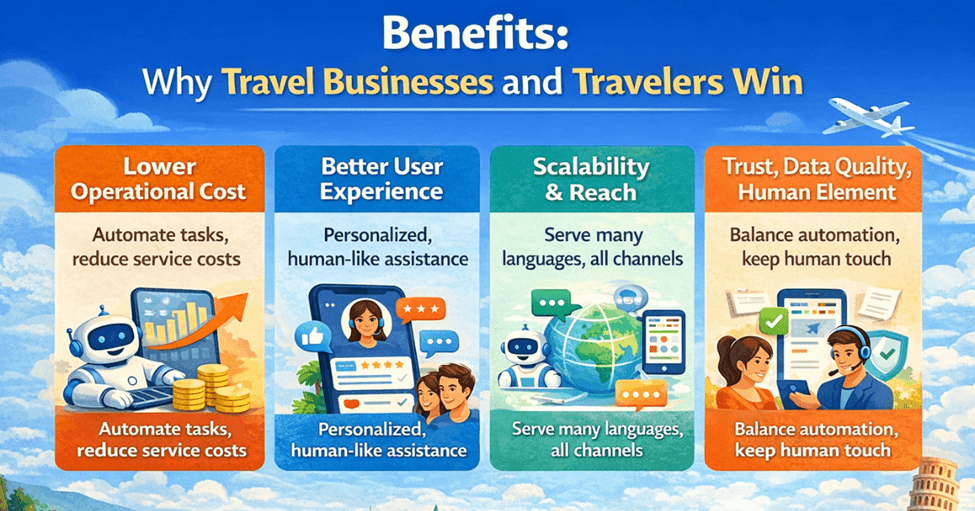
Lower operational cost
Bots and AI agents reduce repetitive work. Industry analyses and chatbot studies have repeatedly shown significant cost savings when companies automate routine customer service workflows (reductions in contact volume and hours saved). This saves headcount and frees skilled agents to solve complex cases.
Better user experience
Agentic AI can deliver personalized, context-aware recommendations and honest, human-like conversations if it’s built on good data and with guardrails. That means faster bookings, fewer clicks, and fewer surprises for travelers.
Scalability & reach
A single agentic system can serve millions of micro-interactions - supporting voice and chat, multiple languages, and rich automations - without linear increases in staffing. This is especially valuable for B2B white-label platforms (like Bookit N Go) that need to offer consistent service across many partner brands.
Trust, data quality, and the human element
Disclaimer: Customers don’t automatically love AI in customer service. Several surveys and analyst reports show customers worry about AI handling sensitive issues and prefer human contact for complicated cases. That’s why the most effective deployments combine Zoe-style agents with clear escalation paths and transparency about what the AI can and can’t do. The balance is: automate routine, keep humans ready for nuance.
Data quality is also crucial. Agentic AI’s decisions are only as good as the inventory, contracts, and documents it has access to messy or stale data leads to bad decisions. Industry reporting emphasizes strong governance, explainability, and auditing as prerequisites for safe adoption.
Real examples beyond Zoe
Several players are experimenting with agentic capabilities:
Hopper has long invested in predictive pricing and automation; the industry has seen Hopper and others add increasingly agentic booking features. (Hopper’s app and B2B investments show how predictive AI + automation can convert behavior into bookings.)
Open-source and research projects demonstrate multi-agent travel planners built on large models and orchestration frameworks, showing the technical feasibility of multi-step autonomous agents.
Conclusion
Agentic AI like Zoe is not about replacing the travel agent; it’s about doubling the agent’s reach and making travel feel less like a project and more like a conversation. When travel tech pairs intelligent automation with human judgment, travelers get faster outcomes and businesses unlock scale and efficiency. Done responsibly with clear opt-in, good data hygiene, and smooth human handoffs, agentic AI can become the quiet travel companion we all want for our next trip.
If you are in the hospitality or travel business, please reach out to us to book a free demo of our product suite at hello@bookitngo.com
FAQs
What does agentic AI mean in travel booking?
Agentic AI is, to put it simply, a kind of AI that can perform different actions. Not only does it display flight alternatives, but it can also route, compare prices, create itineraries, and book flights on your behalf.
How is agentic AI different from a standard travel chatbot?
A significant difference between them is that while typical chatbots provide answers to queries and stop there, agentic AIs take over the entire process — they search, choose from options, and carry out actions like bookings or cancellations, more like a human travel agent would.Does agentic AI work through voice or chat?
Agentic AI can communicate with both. Tourists can type or speak naturally, switch between voice and chat, and continue the booking discussion later without having to restart.Is agentic AI meant to replace travel agents?
No. The primary purpose of agentic AI use is to reduce the workload associated with repetitive tasks. Human agents are called for very complex itineraries, special requests, and situations where travelers want personal assistance.
Is it safe to book with agentic AI?
It depends on the quality of the data used and the rules governing the AI. Most platforms use a combination of automated systems and human monitoring to ensure travelers do not get stuck in unusual situations.