AI-Powered CRM, Travel Technology
Sep 21, 2026
Role of CRM in Travel Business

Bookit N Go Team

Role of CRM in Travel Business
A traveler emails about a family trip to Greece. Someone on the team replies, promises to send options by Friday, and makes a note in a notebook. Meanwhile, a WhatsApp message about the same trip lands with another agent, and a third inquiry from the website form sits unopened in a shared inbox.
Nobody is being careless. The business is simply growing faster than its systems.
That's where a travel CRM starts to matter. It gives a travel business one place to keep every traveler, every inquiry, and every conversation, so that growth adds revenue instead of chaos.
Add AI to the mix and a CRM does more than keep records. It helps your team see what needs attention next.
Here is how CRM supports growth for agencies, TMCs, tour operators, and DMCs, and what to look for when choosing one.
What is CRM in the Travel Industry?
CRM stands for customer relationship management. Salesforce describes it as a system that brings company data together and connects customer touchpoints. In a travel business, that idea becomes very practical.
Think about what your team handles every day: traveler profiles, inquiries, past bookings, destination preferences, quotes, follow-ups, and the small notes that make a client feel remembered. In many agencies, this sits across inboxes, spreadsheets, chat threads, and individual memory.
A travel CRM pulls it into a single record. When a traveler calls, anyone on the team can see what they booked last year, what they asked about last week, and what is still waiting for a reply.
Why CRM Matters More as a Travel Business Grows
A few inquiries a week can be managed with good habits. A few hundred cannot.
Growth brings more inquiries, channels, follow-ups, and preferences to remember. It also brings more chances for something to slip through. A quote that never got chased. A repeat client who was never contacted. A corporate contact who left, with no record of their replacement.
A CRM adds structure around relationships, so the business can handle more volume without losing the personal touch travel customers expect.
How CRM Supports Travel Business Growth
Better Lead and Inquiry Management
Inquiries arrive by email, phone, website forms, social media, and messaging apps. Good travel lead management starts here: a CRM captures each inquiry in one place, sorts it into a lead, and assigns it to a consultant.
Every lead also carries a stage, such as new, quoted, or booked, with the full communication history attached. If an agent is on leave, a colleague can pick up the conversation without asking the client to repeat themselves.
Faster and More Consistent Follow-Ups
In travel, a fast, useful reply can make the difference. A quote sent three days late gives a competitor time to answer first.
Reminders, sales tasks, and automated follow-ups help teams respond while interest is still fresh. Lead status tracking shows who has gone quiet. Follow-up stops depending on who remembered.
More Personalized Traveler Experiences
Travel is personal. A client who always flies a certain airline or travels with two children wants a different conversation from a first-time inquirer.
A CRM stores these details: past destinations, preferred airlines, hotel preferences, travel frequency, typical budget, corporate travel requirements, and notes from earlier conversations. With that in front of them, agents can recommend something relevant on the first reply instead of asking the same discovery questions again.
Clients notice when you remember them, which can help smaller agencies compete with large online platforms.
Stronger Customer Retention and Repeat Business
The relationship should not end when the trip does.
A CRM makes it easier to check in after a traveler returns, send a seasonal idea, or suggest a destination based on what they enjoyed before. For corporate clients, it keeps the account relationship active between bookings.
None of this needs to be elaborate. A well-timed message from someone who remembers the last trip can bring the next booking, and repeat customers can be a steadier source of revenue than constant new-lead hunting.
Cross-Selling and Upselling Opportunities
Customer records often reveal what is missing from a booking. A client with flights and a hotel but no transfers. A family heading to a destination known for excursions. A business traveler booking a long trip with no insurance.
With booking history and preferences in one place, agents can suggest transfers, activities, insurance, or packages at the right moment. Done well, it feels like good service rather than a sales push.
Better Corporate Account Management for TMCs
Managing a corporate client is a different job from managing a leisure traveler, with multiple contacts, many travelers, and contract terms.
For a Travel Management Company, a CRM can organize corporate accounts, key contacts, traveler profiles, contract details, communication records, and open sales opportunities. Account managers can see what has been discussed, what was promised, and when a renewal is approaching.
When an account manager changes, the relationship history stays with the company.
Improved Sales Team Productivity
Many teams still depend on individual inboxes, personal notes, spreadsheets, and manual reminders. That works until someone is busy or leaves. Centralized records make collaboration easier between consultants, sales teams, and management, so teams spend fewer hours hunting for information and more time talking to customers.
Better Pipeline Visibility and Decision-Making
Pipeline visibility shows which inquiries are active, which are close to booking, and which have gone cold, so teams can focus on the opportunities most likely to convert. Reporting goes further. Which lead sources produced bookings? Where do opportunities stall? Which customer segments book repeatedly? How quickly are follow-ups happening? You cannot fix a leak you cannot see.
Deloitte’s overview of CRM points to this shift from guesswork to data-informed decisions. In travel, that can influence everything from staffing to marketing spend.
What Does AI Add to a Travel CRM?
A traditional CRM stores what your team enters. An AI-powered CRM can also help decide what to do with it.
In practice, that can mean:
summarizing a long inquiry thread so an agent can pick it up in seconds,
drafting a first reply that the agent reviews and personalizes,
flagging inquiries that have gone quiet and suggesting when to follow up,
suggesting likely add-ons, such as transfers or insurance, based on a traveler’s history,
spotting patterns in reports, such as which lead sources tend to turn into bookings.
The point is not to replace agents. Travel is personal, and clients still want a person who understands them. AI takes on the repetitive work so agents have more time for the conversations that win bookings.
One caution: AI is only as good as the data behind it. A CRM that holds complete, current traveler records gives AI something useful to work with, which is another reason to get the foundation right first.
Bookit N Go has been building AI into travel technology through Zoe, its AI travel assistant, and has written about how agentic AI is changing the way people book travel. For a closer look at what an AI travel assistant does, see the features of Zoe.
CRM and Travel Technology Integration
A CRM is useful on its own, and far more useful when connected to the rest of your travel technology.
Think about the systems your team already uses: booking platforms, travel ERP, accounting tools, email, messaging apps, and supplier connections. When a CRM connects with them through APIs, a booking made in one system can update the customer record in another, and nobody has to retype details.
This is one reason Bookit N Go’s guide to building a complete travel booking ecosystem treats CRM as one part of a wider, API-driven setup. For distribution-focused businesses, Nexel, Bookit N Go’s white-labeled B2B platform, shows what bringing agent management, pricing, and booking into one place looks like.
How Different Travel Businesses Can Use CRM
Travel Agencies
A CRM for travel agencies earns its place through inquiry handling and memory: track every lead, keep traveler history, schedule follow-ups, and use past trips to spark the next one.
Travel Management Companies
A CRM for TMCs is built around account-level structure: corporate contacts, traveler profiles, service history, and renewal opportunities. For the booking, approval, and expense side of corporate travel, see Nevo, Bookit N Go’s corporate travel platform, and its article on a corporate travel management platform for enterprises.
Tour Operators
A CRM for tour operators helps with package inquiries, group bookings, and long planning cycles. It tracks who asked about which departure, prompts follow-ups before seats fill, and makes it easier to bring past guests back.
DMCs
DMCs work with partners, agents, and clients at the same time. A CRM can hold partner relationships, incoming itinerary requests, quotes in progress, and communication with each account, so nothing is lost between proposal and confirmation.
What Should a Travel Business Look for in a CRM?
Not every travel agency CRM software suits every business. A few questions help:
Travel suitability: Does it handle itineraries, repeat travelers, group inquiries, and corporate accounts, or is it a generic sales tool?
Ease of use: If agents find it slow, they will go back to spreadsheets.
Pipeline and profiles: Can you see every inquiry, its stage, and each traveler’s preferences at a glance?
Automation and AI: Can it handle reminders and follow-ups, and does any AI feature save real time while leaving your agents in control?
Integrations: Does it work with your booking, accounting, and other systems?
Scalability, customization, and security: Will it grow with you, fit your process, and protect traveler data?
Start with your own bottlenecks. The right CRM is the one your team will actually use.
CRM Is More Than a Customer Database
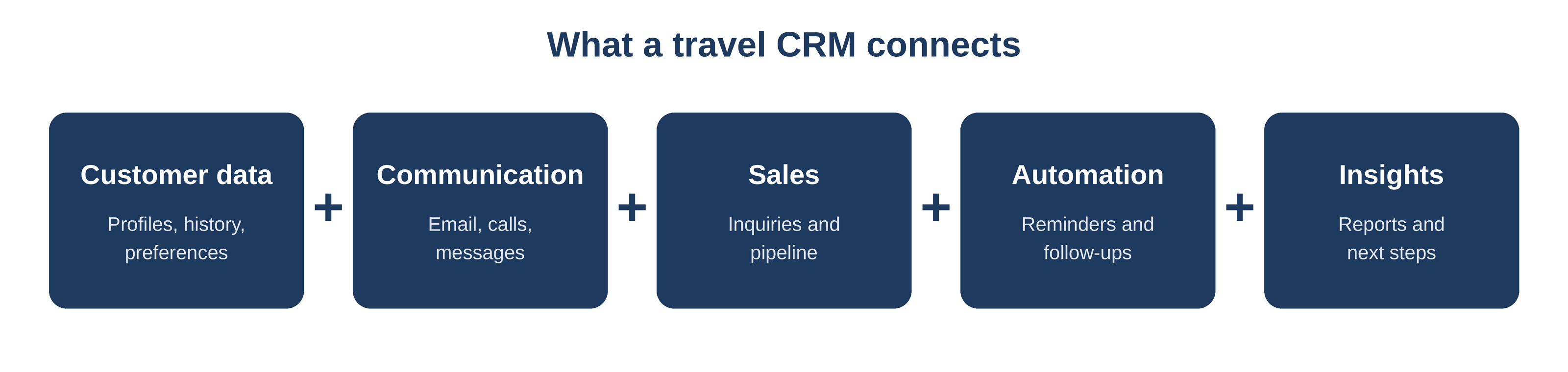
A CRM is not a digital address book. The value appears when customer data, communication, sales, automation, and insights work together. Data tells you who the traveler is. Communication keeps the conversation going. Sales tracking shows where the opportunity stands. Automation handles the routine tasks. Insights show what to do next.
That combination is what lets a travel business grow without becoming harder to run.
Travel CRM FAQs
What is a travel CRM?
A travel CRM is software for managing customer relationships in travel. It keeps traveler profiles, inquiries, booking history, and follow-ups in one place, so teams can manage leads, personalize service, and track sales.
What is an AI-powered travel CRM?
An AI-powered travel CRM is a customer relationship management system that uses AI to help with everyday tasks, such as summarizing conversations, drafting replies, and suggesting follow-ups. Agents stay in control, and the AI works from the traveler data stored in the CRM.
Do travel agencies need a CRM?
Not on day one. A small team can cope with spreadsheets and good habits. A CRM starts to pay off when inquiries arrive through several channels, more than one person handles each client, or follow-ups are being missed.
What is the difference between a CRM and a booking system?
A booking system handles searching, booking, and ticketing. A CRM handles the relationship around it: who the traveler is, what they asked, what was promised, and what happens next. They work best when connected.
Can a CRM help TMCs, tour operators, and DMCs, not just agencies?
Yes. TMCs use it for corporate accounts, contacts, and renewals. Tour operators use it for package inquiries, group bookings, and repeat guests. DMCs use it to manage partner relationships and itinerary requests.
Conclusion
Go back to that Greece inquiry. With a CRM, you capture it once, assign it to one agent, follow up on time, and remember it long after the trip.
That is the real role of a travel CRM in business growth. It helps teams manage inquiries, follow up consistently, understand customers, see the sales pipeline, encourage repeat business, work more efficiently, and make better-informed decisions.

Jimmy - Bookit N Go editorial team
Bookit N Go Team writes about travel technology for travel agencies, TMCs, tour operators, and DMCs. Bookit N Go is an AI-powered travel technology provider offering white-labeled platforms.
Talk to Bookit N Go
Every travel business manages customer relationships a little differently. If your travel agency, TMC, tour operator, or DMC is rethinking how it handles inquiries, follow-ups, and repeat business, we would like to hear what is working and what isn't.
Get in touch with the Bookit N Go team to talk through your requirements, or explore our travel platforms.
Related reading
• How to Build a Complete Travel Booking Ecosystem for Your Business
• The Future of B2B Travel: Where Automation Meets Scalability